



Wonach suchst du?
 Startseite
/
Can "upright" photovoltaic modules—positioned to generate power during off-peak hours—truly lead to "higher earnings despite lower output"?
Oct 20, 2026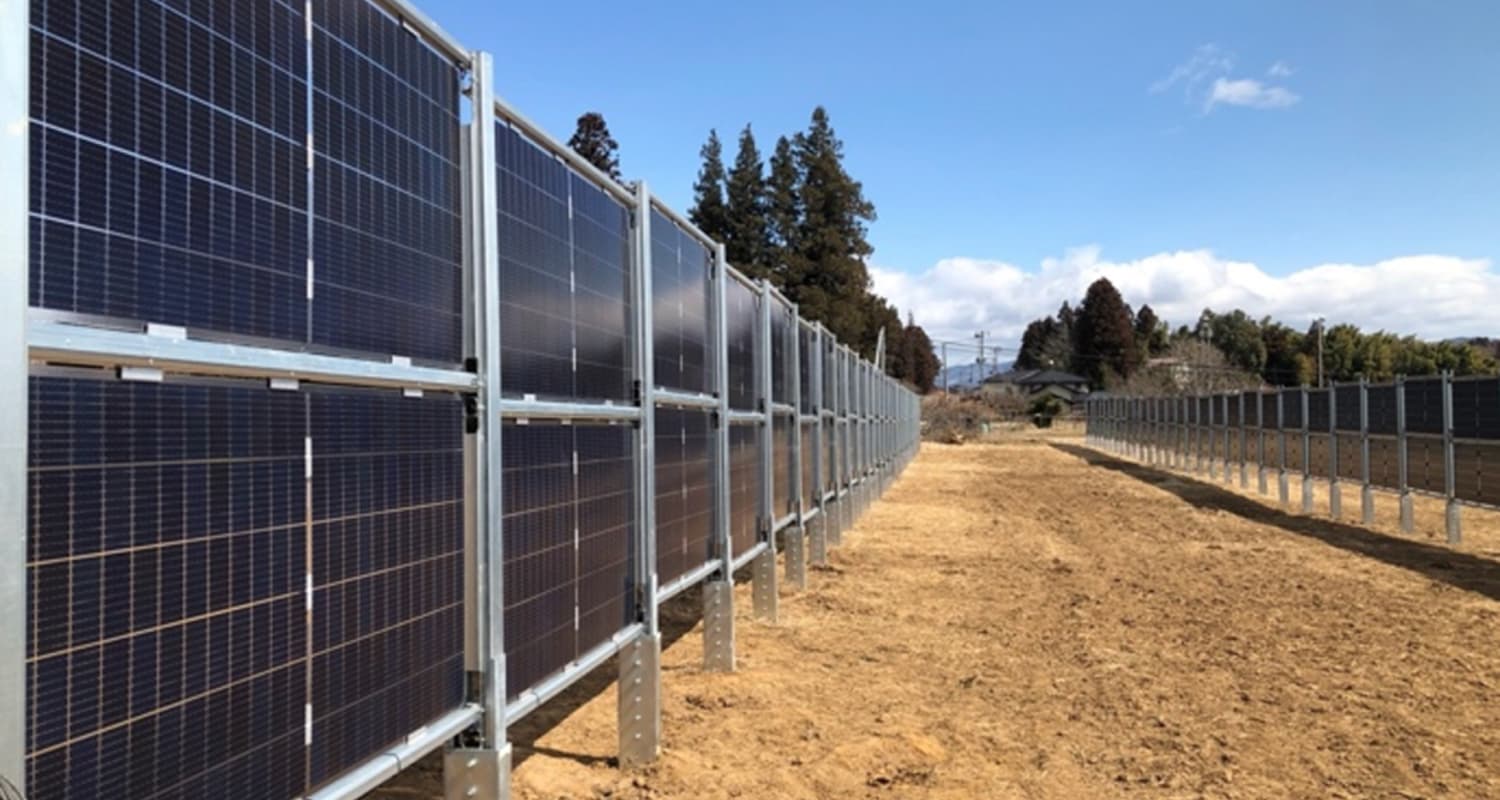
On October 10, a "photovoltaic string"—stretching two to three hundred meters—appeared above a stretch of farmland in Haikou. Dozens, or even hundreds, of bifacial photovoltaic (PV) panels were linked together and suspended vertically in the air. Power output peaks from sunrise until around 9:00 AM, with another surge occurring between 3:00 PM and sunset; conversely, activity dips during the midday hours. This project, dubbed "string-style photovoltaics," officially launched its commercial operations that same day.
Vertical installation is not a new concept to the industry. Over a year ago, interest in vertical PV in China was primarily driven by shifts in electricity pricing signals. Today, as the market-oriented reform of electricity pricing deepens, discussions around this approach have moved beyond mere "concepts" toward "practical, on-the-ground validation."
01. Industry Pain Points: The Mismatch Between Output and Price, and Land Scarcity
Why has vertical installation been brought up repeatedly? It addresses two persistent contradictions within the industry.
The first is the mismatch between power output and electricity pricing. With traditional, south-facing, tilted PV installations, peak power output occurs at midday—precisely when electricity prices are at their lowest. Whether due to "valley" pricing periods or troughs in the spot market, the times when PV systems generate the most power often coincide with the lowest electricity prices, creating a scenario where "peak output aligns with price troughs."
The second issue is land constraints. Large-scale, ground-mounted PV plants require significant space, and site selection is restricted by policies aimed at preventing the conversion of arable land for non-agricultural or non-grain-producing purposes. In regions where land is scarce, building power plants near load centers has become increasingly difficult.
Vertical installation—or "peak-shifting" power generation—has gained attention precisely because it addresses both of these challenges: it reduces the land footprint through vertical or suspended mounting, while shifting power generation away from midday toward the morning and evening hours, better aligning the generation curve with the price curve.
02. Precedents and Comparisons: From Rooftop Pilots to Agri-PV Integration
In recent years, various approaches to vertical installation have been explored both domestically and internationally, involving different technical pathways and varying levels of maturity. These projects employ diverse technical approaches—such as heterojunction (HJT), perovskite, and conventional bifacial modules—and are deployed across varied settings, including rooftops, farmland, and utility-scale demonstration sites. This indicates that vertical installation is not the unique vision of a single company, but rather a strategy independently explored by multiple stakeholders in response to shifting electricity price signals. In China, the deployment of such projects is set to accelerate significantly by 2026, with most initiatives following a "power generation + agriculture + zero additional land footprint" model. It should be noted, however, that the vast majority remain in the demonstration or pilot phase, far from large-scale commercial adoption.
03. Case Analysis: The Economics of Off-Peak Power Generation
The value of vertical installation lies not in "generating more electricity," but in "generating electricity during higher-priced periods." This requires a detailed economic breakdown.
Key findings: If all generated electricity is settled at spot market prices, vertical installation—despite a potential 0.5%–23% reduction in daily energy yield—can actually increase revenue by 0%–224%. The loss in total generation volume is primarily concentrated during months with lower prices and midday periods when prices are at their lowest.
In simple terms, vertical installation involves trading a portion of "low-value" (cheap) electricity for a greater amount of "high-value" (expensive) electricity. As the focus of revenue shifts from sheer "volume" to "price," this trade-off becomes economically advantageous.
It is important to note that these calculations are based on specific parameters—such as the spot market in Shandong province, particular module types, and typical clear-sky conditions. Changing the regional price curve, solar irradiance levels, or module specifications could alter the conclusions. Ultimately, the economic viability of vertical installation depends on local peak-to-trough price spreads and the specific shape of the spot market price curve.
04. Policy Context: The Phasing Out of Fixed Time-of-Use Pricing Amplifies the Value of Off-Peak Generation
Since May 2025, the marketization of electricity pricing has taken a major step forward. "Midday troughs"—periods of exceptionally low electricity prices—have become a widespread phenomenon; 22 provinces across China have now designated midday hours as low-price, off-peak periods. The industry’s growing interest in vertical installation is, in large part, a direct response to these fixed, low-price signals during the middle of the day. Over the past year, a series of policies have been implemented:
• By the end of 2025, provincial-level spot electricity markets are expected to achieve near-total coverage—a key milestone in the initial establishment of a unified national electricity market.
• On December 17, 2025, the National Development and Reform Commission (NDRC) and the National Energy Administration (NEA) jointly issued the "Basic Rules for the Medium- and Long-Term Electricity Market" (NDRC Energy Regulation [2025] No. 1656). Effective March 1, 2026, market participants—entities directly engaged in electricity trading—will no longer be subject to government-mandated time-of-use (TOU) electricity price levels or specific time slots. In short, TOU pricing is shifting from "government-set" to "market-driven."
• To date, 11 provinces and municipalities have issued relevant policy documents. Nine of these—Guizhou, Hebei (Southern Power Grid region), Hubei, Shaanxi, Jilin, Yunnan, Chongqing, Liaoning, and Henan—have officially abolished fixed, government-mandated TOU pricing, while Jiangsu and Shanxi are currently in the public consultation phase.
It is important to clarify a key point: what has been abolished is the government-set fixed TOU pricing. The mechanism of time-based pricing itself remains; the authority for setting these prices has simply shifted from the government to the market. Under market-based pricing, price signals more accurately reflect real-time supply and demand: prices drop during midday—when solar photovoltaic (PV) generation peaks—and rise during morning and evening periods when supply is tight relative to demand. This is a tangible benefit for the "peak-shifting" logic of vertically installed solar panels: by shifting peak power generation to periods when market prices are higher, the revenue model becomes more robust than it was during the era of "fixed low-price midday electricity."
Local authorities are also actively driving this transition. Starting October 1, 2026, Shandong Province will implement a new time-of-use (TOU) electricity pricing scheme for industrial and commercial users. This includes a 70% premium during peak hours, a 70% discount during off-peak hours, a 100% premium during "super-peak" (peak-of-peak) hours, and a 90% discount during "deep off-peak" hours—effectively widening the price spread between peak and off-peak periods to 3–4 times. Meanwhile, Zhejiang Province issued a new policy in May 2026, effective from July, which eliminates the morning peak period, extends the midday off-peak window from two to three hours, and designates the afternoon-to-evening block as a peak period. Both provinces are restructuring their TOU pricing to address the "duck curve" phenomenon, concentrating higher prices during periods of tight supply and demand.
For the photovoltaic (PV) industry, the ability to generate electricity during high-price periods translates into higher revenue. Vertical installation—a strategy for shifting generation away from traditional peak hours—is one way to respond to these market signals.
However, market-oriented reforms also bring challenges: as TOU price fluctuations shift, the arbitrage opportunity for traditional industrial and commercial energy storage systems—which rely on capturing the spread between peak and off-peak prices—is narrowing. (Based on projections under Zhejiang’s new policy, the return on investment for energy storage projects could drop to approximately 16%.) Consequently, the industry is shifting its focus from simple price-spread arbitrage toward operational excellence. The financial viability of vertical installations must also be validated through actual market settlement data, rather than relying solely on theoretical projections.
05. Unresolved Issues: Hurdles for Vertical PV Installations
It is worth noting that several significant obstacles must be overcome before vertical PV installations can achieve large-scale commercialization.
First, economic viability depends on specific boundary conditions. The reduction in power generation associated with vertical installation is inversely correlated with latitude; it offers clear advantages at higher latitudes, while resulting in greater losses at lower latitudes. In a low-latitude region like Hainan, the economic rationale for a project—such as the one in Haikou—requires validation through more transparent project data and long-term operational performance; it is unwise to extrapolate from a single case study.
Second, structural safety and costs are critical concerns. Vertical installations—especially those that are elevated—place higher demands on structural design and wind-load resistance. In the southeastern coastal regions, where typhoons are frequent, wind resistance is an absolute necessity (the "swaying" wind-resistant design of the Haikou project is a direct response to this). Furthermore, reinforcing the structure inevitably drives up initial investment costs. Whether the savings from reduced requirements for pile foundations, cabling, and energy storage can offset the costs of the mounting structure is something that can only be determined through calculations based on actual projects.
Third, there is a higher demand for the bifaciality of solar modules. In a vertical installation, the rear side of the module contributes significantly more to total power generation—compared to only about 5% in traditional installations—necessitating a higher bifaciality factor. Heterojunction (HJT) technology, with its symmetrical bifacial structure and a bifaciality factor exceeding 90%, is considered well-suited for vertical configurations (the Haikou project, for instance, utilizes HJT modules). However, this also implies that vertical installations may become tethered to specific module technologies, thereby raising both technical barriers and costs.
Fourth, there is a lack of established standards, acceptance criteria, and business models. Currently, vertical installations lack mature product standards, as well as unified protocols for project acceptance, subsidies, or settlement; most initiatives remain at the stage of demonstration or empirical testing. The transition from individual cases to regional pilots—and eventually to a replicable business model—remains a long journey.
Fifth, the claim that such systems "do not occupy land" is relative. While vertical, elevated structures avoid the direct occupation of arable land, the mounting racks, pile foundations, and access paths for operations and maintenance still require space. The actual extent of land savings must be carefully evaluated based on the specific land-use context.
Conclusion
Overall, vertical installation—and the associated "peak-shifting" power generation—is not intended to replace traditional installations set at an optimal tilt angle. Rather, it serves as an additional option for "hybrid deployment" in an environment shaped by both the marketization of electricity prices and land-use constraints. Its value lies not in maximizing total generation, but in "generating power at the right time to capture the best market price."
A little over a year ago, the industry largely viewed this concept as a theoretical hypothesis based on electricity price modeling. Today, projects in locations such as Haikou, Zhenjiang, and Zhangjiakou are moving the concept into real-world settings for validation. Whether this approach can evolve from small-scale demonstrations to widespread, large-scale application depends on several factors: the evolution of electricity price curves, the maturity of module and structural technologies, cost controllability, and the development of supporting policies and standards. Only when these elements align can this approach truly gain traction.



5th floor, Block A, Science Avenue,High-tech District, Hefei , Anhui .China